
Quick answer
Use AI to find things. Be careful letting it pay
AI is already useful for comparing products. If you let an agent pay, give it a card with a low limit, require approval for every purchase, and check each charge. Who pays when an agent buys the wrong thing is still unsettled.
What has actually launched
In late April 2025, Mastercard announced Agent Pay and Visa launched Visa Intelligent Commerce. Both are designed so that an AI agent never sees your real card number: it gets a token instead, and you can set spending limits and rules for what it may buy. Mastercard also requires agents to be verified before they can pay.
On September 29, 2025, OpenAI and Stripe launched Instant Checkout in ChatGPT, letting US users buy from Etsy sellers inside a chat, with Shopify merchants to follow. Payment used a token limited to one merchant and one cart total.
Then it slowed down. In March 2026, Retail Gazette reported that OpenAI was scaling back Instant Checkout after weak uptake and repositioning ChatGPT shopping around finding and comparing products, with merchants using their own checkouts.
Shoppers aren't sure
Fraud-prevention company Riskified surveyed 2,000 consumers in the US and UK for its first-quarter 2026 report. 61.5% had used AI to find products, but 55% were not comfortable with AI agents buying on their behalf. Asked who should be responsible for an unauthorized agent purchase, 50.8% said the AI platform and 18.7% said themselves. 73.9% expect biometrics or a one-time passcode before an agent can pay.
What six banks are worried about
In September 2026, Bank of America, Capital One, ING, NatWest, Commonwealth Bank of Australia and ASB published shared principles for safer "agentic commerce": transparency, safety, privacy and data, choice, and interoperability. Their concerns include attackers impersonating agents or merchants, weaker payment protections, and unclear responsibility when an agent makes a mistake. The principles are voluntary; the banks' point is that adoption is moving faster than safeguards.
The question nobody has answered: who pays for a mistake?
Card disputes are built around whether you authorized a payment. With an agent, you gave it permission in general, but you may not have authorized that particular purchase. A June 2026 analysis by chargeback company Justt says no jurisdiction had yet passed rules specifically covering autonomous AI purchases. Until that's settled, keep your own proof: what you asked for, what the agent showed you, and what it bought.
Limits to set before an agent touches your card
- Use a separate card or virtual card with a low limit, not your main debit card.
- Require approval for every purchase rather than letting the agent buy on its own.
- Don't let an agent start subscriptions or recurring payments without checking them yourself.
- Check the merchant name and total on the confirmation before approving.
- Save screenshots of what you asked for and what was ordered.
- Check your card statement weekly, and turn off agent access when you're not using it.
When buying takes one sentence
Friction is one of the things that protects a budget. When checking out takes one sentence, small purchases get easier to make and easier to forget. Treat anything an agent buys like any other purchase: record it, and look at the total at the end of the week.
- Add each purchase an AI makes right after you approve it, with the card as the paid-from account.
- Compare History with your card statement each week.
- Open Insights to see repeated purchases and what they add up to.
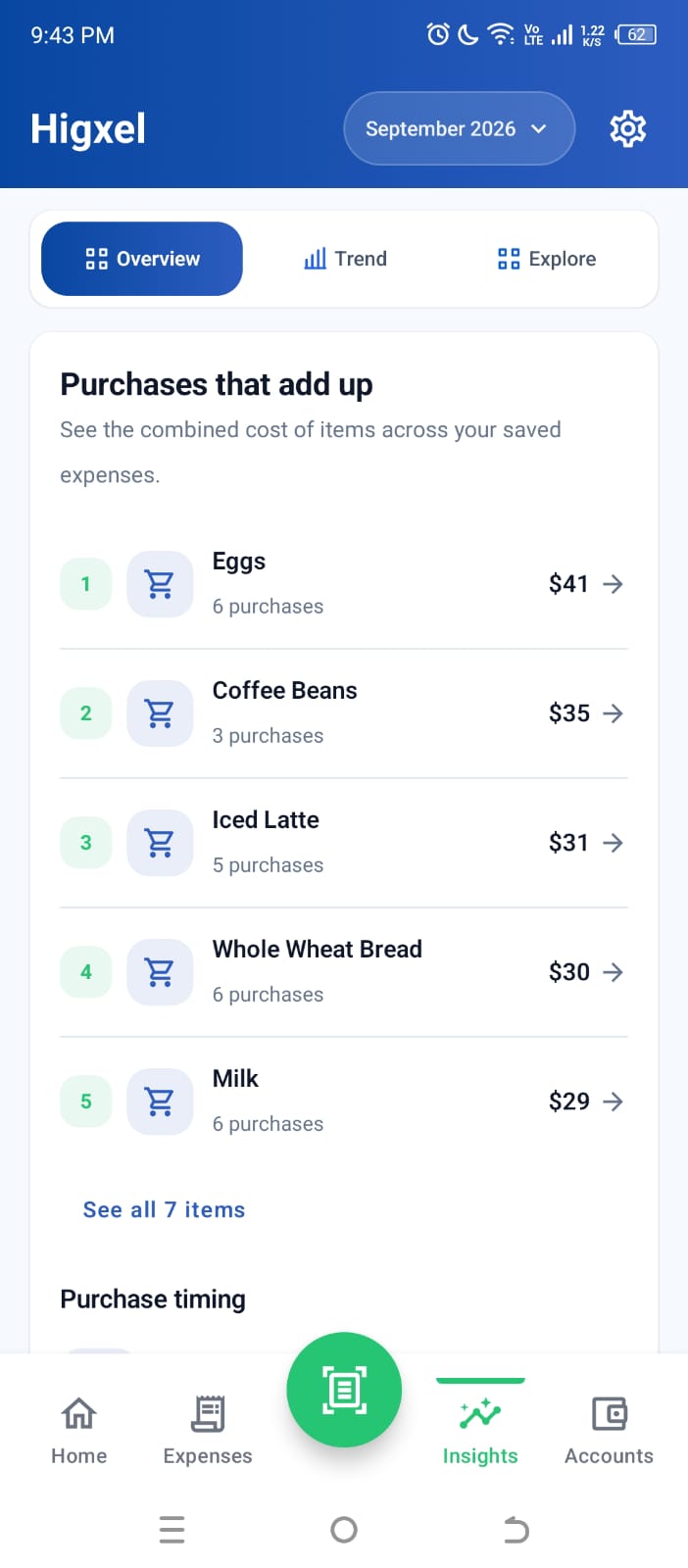
Screen shows sample data.
FAQ
Common questions
Does an AI agent see my card number?
With the Visa, Mastercard and Stripe systems, the agent uses a token instead of your real card number.
Can an agent buy without asking me?
It depends on the service and your settings. Choose approval for every purchase where you can.
Will my bank refund a wrong purchase made by an agent?
It isn't clear yet. Contact your bank quickly, and keep records of what you asked the agent to do.
Written with AI assistance by Higxel Editorial. Example figures are made up to show the method; this is general information, not financial advice. Sources checked October 29, 2026. Some sources describe one country; local rules and costs differ.
Sources
Further reading
- Digital Commerce 360: Visa and Mastercard launch agentic commerce tools
- Stripe: Instant Checkout in ChatGPT and the Agentic Commerce Protocol (September 29, 2025)
- Retail Gazette: OpenAI pivots ChatGPT shopping strategy (March 2026)
- Digital Transactions: many consumers say no thanks to agent-based payments (Riskified)
- eSecurity Planet: six banks warn AI shopping agents could create new fraud risks (September 2026)
- Justt: who pays when an AI agent gets it wrong?