
Quick answer
Use AI to organize and explain, not to decide
AI is good at turning a list of spending into categories, explaining terms and suggesting options. It's weaker on precise figures, tax rules and anything local or recent. Give it totals rather than statements, ask it to show its arithmetic, and check the numbers yourself before you act.
You're not the only one asking
An Experian survey of 2,011 US adults found 67% of Gen Z and 62% of millennials use AI for their personal finances, and 60% of those users use it for saving and budgeting. In the UK, Finder found 40% of adults had used a generative-AI tool for money advice, and 19% had used it for budgeting.
What happened when researchers tested the chatbots
In September 2026, UK technology firm Saturn published a test of 17 AI models—free and paid versions of ChatGPT, Gemini, Claude and Copilot. Each model answered 121 money questions five times, more than 10,000 answers in all.
| Measure | Result |
|---|---|
| Average accuracy | 43% (wrong 57% of the time) |
| Hard, multi-part questions with tax rules and exact figures | 12% correct |
| Easy, general money questions | 54% correct |
| Free models | Wrong 63% of the time |
| Paid models | Wrong 49% of the time |
| Best single model | 61% correct |
Most failures weren't wild inventions. 37.1% were incomplete answers and 18.4% left out a required figure, limit or deadline. Smaller shares invented a rule (6.1%) or used outdated guidance (2.3%). An earlier test, published in January 2025, asked ChatGPT 100 finance questions and judged 35% of its answers incorrect or unsuitable.
A UK test by consumer group Which? in late 2025 shows how that happens. It asked how to invest a £25,000 annual ISA allowance—a deliberate mistake, because the real limit is £20,000. ChatGPT and Copilot didn't correct it and gave advice that could have pushed someone over the limit.
Where AI genuinely helps
- Sorting a messy list of spending into categories.
- Spotting subscriptions and repeat costs in a list you give it.
- Turning a goal into a monthly amount: "how much a month to reach this by December?"
- Explaining a term or a bill in plain words.
- Drafting a polite message to a landlord, lender or provider.
- Brainstorming ways to cut costs that you then check yourself.
Where it goes wrong
- Long chains of arithmetic, where one slip changes every total after it.
- Tax, benefit and lending rules, which vary by country and change often.
- Current prices, rates and limits.
- Leaving things out—the most common failure in the 2026 test.
- Sounding equally confident whether it's right or wrong.
- Your full situation, which it only knows from what you've typed.
What not to paste
Experts quoted by CNN in May 2026 warned against uploading bank statements and tax returns to AI tools, advising people to check privacy and retention policies, opt out of model training, and redact documents first. Leave out account and card numbers, ID numbers, passwords and full statements. Totals by category are enough for almost every budgeting question.
Three prompts that work
Those costs add up to 75,000, leaving 5,000, so you need to free up 3,000 to save 8,000. If the AI's starting figure is different, stop there and correct it.
A two-minute check before acting on AI money advice
- Redo the key totals yourself or in a spreadsheet.
- Check any rule, rate or deadline on the official website for your country.
- Ask the AI: "What would make this advice wrong for me?"
- For big decisions—debt, investing, tax—speak to a qualified adviser.
- Track expenses in Higxel by hand, by voice, or by scanning receipts.
- Use Home to see your budget, the amount left and your daily allowance.
- Export to Excel, remove anything private, and share category totals when you want help from an AI.
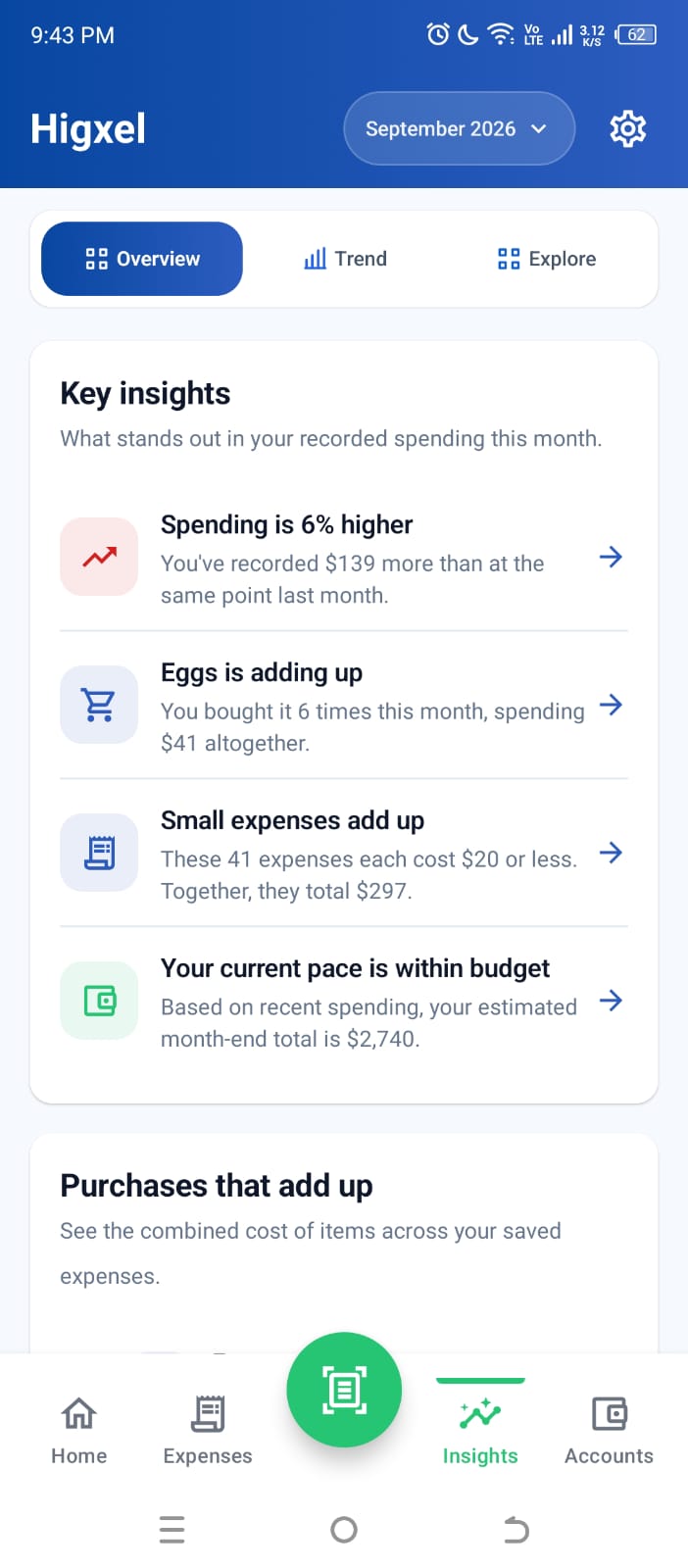
Screen shows sample data.
FAQ
Common questions
Is it safe to ask ChatGPT about money?
General questions are fine. Avoid sharing identifying details, and check numbers and rules before acting on the answer.
Which AI is best for money questions?
In the September 2026 test, the best model was right 61% of the time. None was reliable enough to use without checking.
Can AI replace a financial adviser?
No. A chatbot doesn't know your full situation and has no duty to act in your interest.
Written with AI assistance by Higxel Editorial. Example figures are made up to show the method; this is general information, not financial advice. Sources checked October 29, 2026. Some sources describe one country; local rules and costs differ.
Sources
Further reading
- InvestmentNews: AI chatbots give wrong financial answers most of the time (Saturn study, September 2026)
- Which?: ChatGPT and Gemini among AI tools giving risky consumer advice (November 2025)
- Financial Reporter: AI responds to 35% of financial queries incorrectly (January 2025)
- CU Insight: Gen Z and millennials using AI for personal finance (Experian survey)
- FF News: 2 in 5 Brits have used AI for personal finance advice (Finder)
- WAFB/CNN: experts warn against uploading financial documents to AI (May 2026)