
Quick answer
Hang up, call back, and use a family code word
If a call from someone you love asks for urgent money, hang up and call them back on a number you already have, or ask a question only they could answer. Agree a family code word before you ever need it. Don't send a wire transfer, gift cards or crypto because a caller is rushing you. If you've already paid, call your bank immediately and report it.
One call, ninety minutes, several thousand dollars
A mother in St. Louis, Missouri, identified only as Rachel, answered a call that appeared to come from her college-age daughter's phone. The voice was her daughter's. It said there had been an accident. Then a man took over. He threatened to kill her daughter, said they were watching Rachel, and walked her step by step through wiring money to Mexico.
Over about an hour and a half she sent several thousand dollars. It ended only when her real daughter called. Rachel had recorded the fake call, and she later shared it to warn other parents.
A cybersecurity expert interviewed for the story showed how little the scammers need: using cheap tools, she cloned a reporter's voice from a few seconds of audio, and said fewer than ten seconds of someone's voice can be enough to fool people. The story ran on local TV in March 2026.
How the scam works
- A short clip of a voice. The FTC warns that a scammer needs only a short audio clip, which can come from videos or voice notes posted online, plus a voice-cloning program.
- A number that looks right. Caller ID can be faked, so a familiar name or number on the screen proves nothing on its own.
- Panic and a deadline. An accident, an arrest or a kidnapping, with someone in the background telling you there's no time.
- A payment that's hard to reverse. Wire transfers, gift cards and cryptocurrency are hard to claw back, which is why the FBI warns against sending any of them to someone you know only by phone or online.
How big is the problem?
In its 2025 Internet Crime Report, the FBI's Internet Crime Complaint Center (IC3) counted 22,364 complaints that explicitly mentioned AI, with reported losses of about $893 million. People aged 60 and over filed 3,143 of those complaints and reported $352 million in losses. The report also notes that a complaint is only tagged as AI-related when the victim mentions AI, and many victims never realize it was involved—so the real number is likely higher.
Awareness is low. In a 2024 survey of 3,010 UK adults for Starling Bank, 28% thought they had been targeted by a voice-cloning scam in the past year, and 46% didn't know this kind of scam existed. Starling warned that three seconds of audio from a video posted online can be enough to clone a voice.
It isn't only voices, and it isn't only families. In January 2024, a finance employee at the engineering firm Arup in Hong Kong joined a video call with what looked like the company's chief financial officer and other colleagues. Police later said the participants were digital recreations. The employee made 15 transfers totaling HK$200 million (about US$25.6 million).
Red flags that matter more than the voice
You can't rely on spotting a fake voice. Modern clones are good, and a crying, panicked voice hides small mistakes. Watch the situation instead:
- Secrecy. "Don't tell Mom" or "don't call anyone" is a warning sign, not a detail.
- Speed. You're told to act in minutes and stay on the line while you pay.
- The payment method. A wire to an unfamiliar account, gift-card codes or crypto.
- No callback allowed. The caller gets angry or threatening if you want to hang up and check.
- Odd details. The FBI suggests listening for tone and word choice that don't sound like the person.
Set up a family code word tonight
The FBI recommends a secret word or phrase that your family uses to confirm who's calling. It takes five minutes and works even when the fake is perfect.
- Choose a word or short phrase that isn't on social media—not a pet's name or a birthday.
- Share it in person, and include older relatives, who are targeted most often.
- Agree one rule: anyone who calls asking for money must say the word first.
- Make accounts private where you can, and limit public videos of your voice, as the FBI suggests.
If you already sent money: the first hour
- Call your bank or payment provider now, using the number on your card or its official app, not a number the caller gave you. Ask whether the payment can be stopped or recalled.
- Report it. In the US, use ic3.gov and the FTC's ReportFraud site. In India, call the national cybercrime helpline 1930 or use cybercrime.gov.in; reporting within the first hours gives the best chance of freezing money. In Pakistan, call the National Cyber Crime Investigation Agency helpline, 1799.
- Keep the evidence: the number, the time of the call, any recording, and every transfer receipt.
- Expect a second scam. Someone offering to recover your money for a fee is often the same group trying again. In July 2026 the FBI warned that criminals pose as its complaint center, even using deepfake videos of FBI leaders. The real IC3 never contacts victims directly and never charges to recover money.
- Add any payment you make as an expense straight away, with the amount and the account it was paid from.
- Check History each week for payments you don't recognize.
- If something goes wrong, give your bank the exact amount and time from your record.
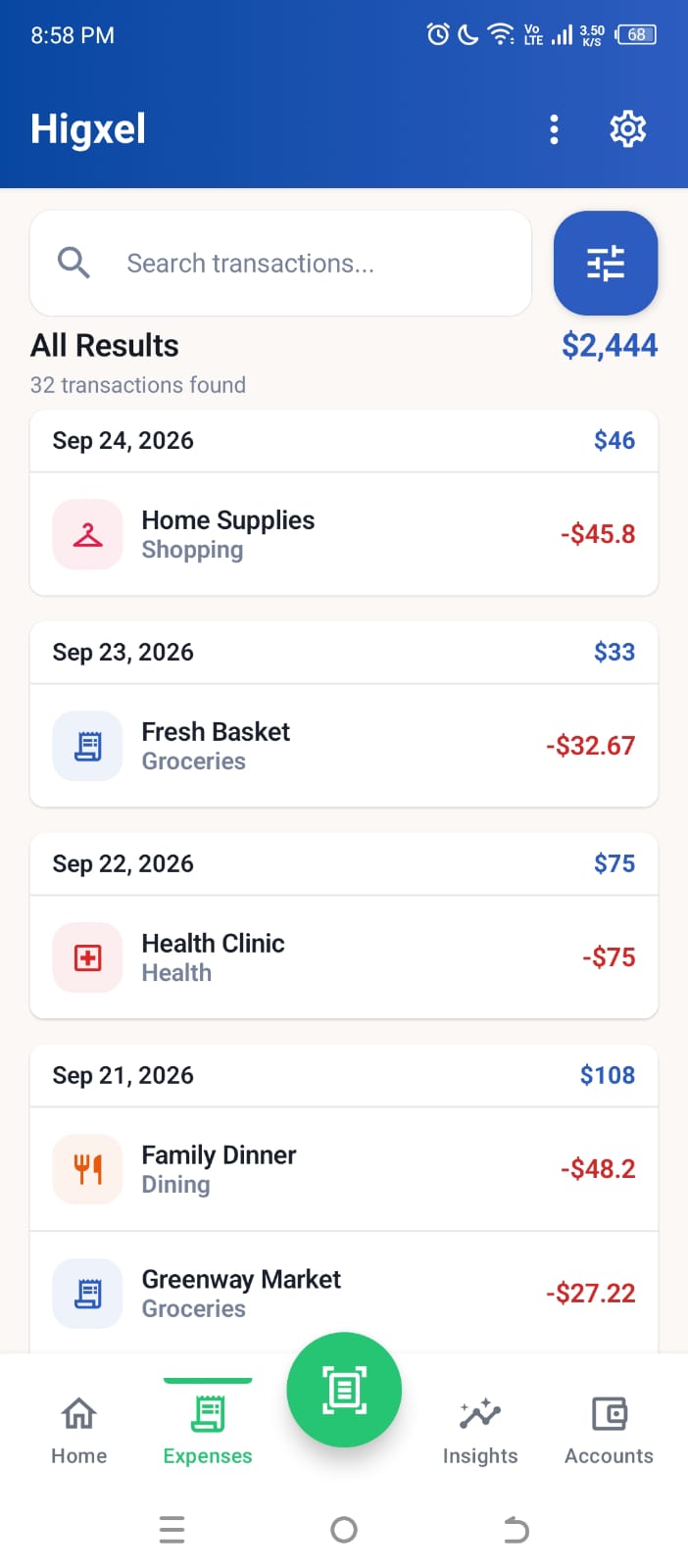
Screen shows sample data.
FAQ
Common questions
How much audio does a scammer need to clone a voice?
Only a short clip. The FTC says a scammer needs a short audio sample, which can come from content posted online.
Will my bank refund money I transferred myself?
It depends on the bank, the payment type and where you live. Payments you approved are often harder to recover, so call the bank as quickly as you can.
Are AI-generated voices in calls illegal?
In the US, the FCC ruled in February 2024 that robocalls using AI-generated voices fall under existing robocall rules. Rules differ in other countries.
Written with AI assistance by Higxel Editorial. Example figures are made up to show the method; this is general information, not financial advice. Sources checked October 29, 2026. Some sources describe one country; local rules and costs differ.
Sources
Further reading
- Federal Trade Commission: scammers use AI to enhance their family emergency schemes
- FBI public service announcement I-120324-PSA: criminals use generative AI to facilitate fraud (December 3, 2024)
- PPC Land: FBI IC3 2025 report, AI-linked fraud figures
- WRDW: mom loses thousands to fake kidnapping call using AI clone of daughter's voice (March 2026)
- South China Morning Post: Arup confirmed as victim of HK$200 million deepfake scam
- Starling Bank: safe phrases campaign and voice-cloning survey (September 2024)
- FBI public service announcement I-072026-PSA: scammers impersonating the IC3 (July 20, 2026)
- Help Net Security: FCC makes AI-generated voices in robocalls illegal
- Moneylife: use the 'golden hour' to report a scam in India
- PhoneWorld: NCCIA cybercrime helpline 1799 launched in Pakistan