
Quick answer
Nobody knows yet, and that is the honest answer
AI spending is growing far faster than AI revenue. In 2026, Big Tech is spending over $700 billion building data centers, while OpenAI, the best-known AI company, expects around $36 billion in revenue and is still losing money. That gap is why people say "bubble". Others point out that the spenders are some of the most profitable companies on earth and that AI revenue is growing fast. Both things are true at once, which is why the debate has no quick answer.
The gap at the center of the debate
Start with the money going in. A Reuters market host put it bluntly in May 2026: the total 2026 spending from the big cloud companies "has now topped $700 billion." Microsoft spent almost $31 billion in a single quarter, up 84% on a year earlier. Meta raised its full-year plan to as much as $145 billion. JPMorgan estimates that global AI-related spending will reach $5.5 trillion by 2030.
Now the money coming out. OpenAI told investors it expects about $36 billion of revenue in 2026, according to a company presentation reported by the Financial Times. In the first quarter of the year it earned $5.7 billion and burned through about $3.7 billion of cash. Its own forecast shows it spending more than it brings in until the end of the decade, with negative free cash flow of $278 billion between 2026 and 2030.
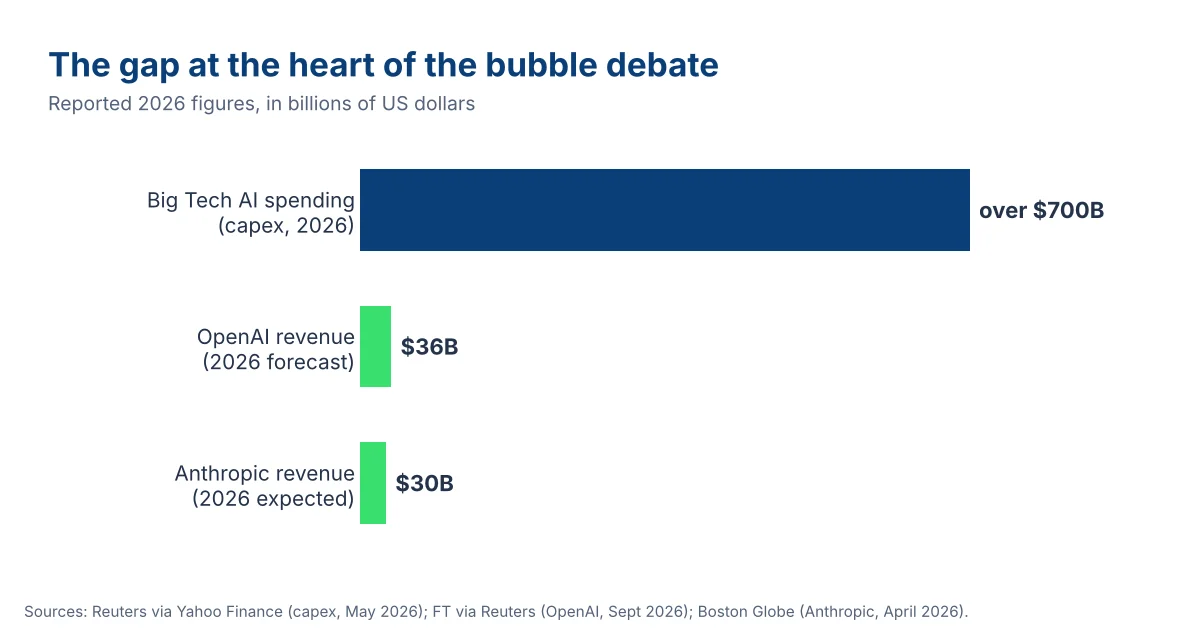
A building boom always runs ahead of the money it earns. The question is how far ahead, and whether the earnings catch up before the lenders get nervous.
The $600 billion question
In September 2023, a partner at the venture firm Sequoia, David Cahn, wrote a short essay asking a simple thing: where is all the revenue? Nine months later he updated it, and the title became famous: "AI's $600B Question."
His math was a rule of thumb. For every dollar spent on AI chips, roughly another dollar goes on the building, the power and the cooling around them. Then the companies renting that computing need to make a profit too, so their customers' revenue has to be about double again. Four times the chip bill, in other words. At the chip spending of mid-2024, that meant about $600 billion a year of AI revenue was needed to make the build-out pay. Real AI revenue was nowhere close.
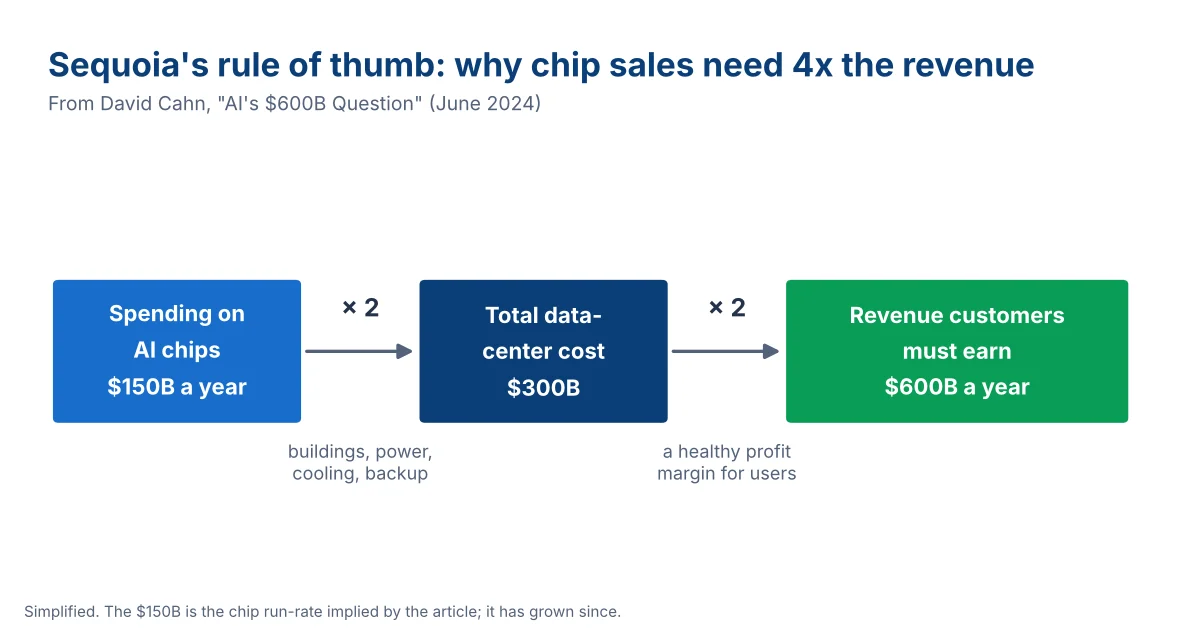
Cahn did not say AI was useless. He argued it would create real value, but that investors who overbuilt would take the losses as chips got cheaper and older ones lost value faster.
Why some people see a bubble
- Few users pay. Analysts quoted by the Boston Globe estimate that only about 5% of chatbot users pay for a subscription.
- Businesses are struggling to profit from it. An MIT study published in 2025, based on about 150 interviews, a survey of 350 employees and 300 public deployments, found that 95% of company AI pilots stalled before reaching wide use.
- The economy leans on the building itself. Harvard economist Jason Furman calculated that spending on information-processing equipment and software was about 4% of the US economy in the first half of 2025, but 92% of its growth. Without it, he estimated, growth would have been about 0.1% a year, though he added that without the boom other parts of the economy would probably have grown faster.
- A lot of it is borrowed. JPMorgan estimates $4.1 trillion of the build-out through 2030 will be financed with debt.
Why others say it is not
- The spenders are rich. Unlike the dot-com era, most of the money comes from companies with huge profits. JPMorgan expects their operating cash flow to exceed $900 billion a year by 2027.
- Revenue is real and growing fast. Microsoft said its AI business was running at $37 billion a year, up 123%. OpenAI's revenue roughly tripled in a year.
- Customers have signed up in advance. Google Cloud reported a backlog of more than $460 billion of contracted work; Microsoft's was $627 billion.
Even the bulls admit the risk is timing. JPMorgan's own conclusion was that the economics hold, "for now."
What it means for an ordinary budget
Whether or not it is a bubble, the AI boom is already in your monthly spending. It shows up in the price of AI subscriptions, in some electricity bills, and in how much of a typical index fund sits in a handful of tech companies. Those three effects are covered in the rest of this series.
- Add each AI subscription you pay for as a recurring expense, with its renewal day.
- Check Insights once a month to see what your subscriptions add up to over a year.
- Review History before a renewal so you can cancel what you no longer use.
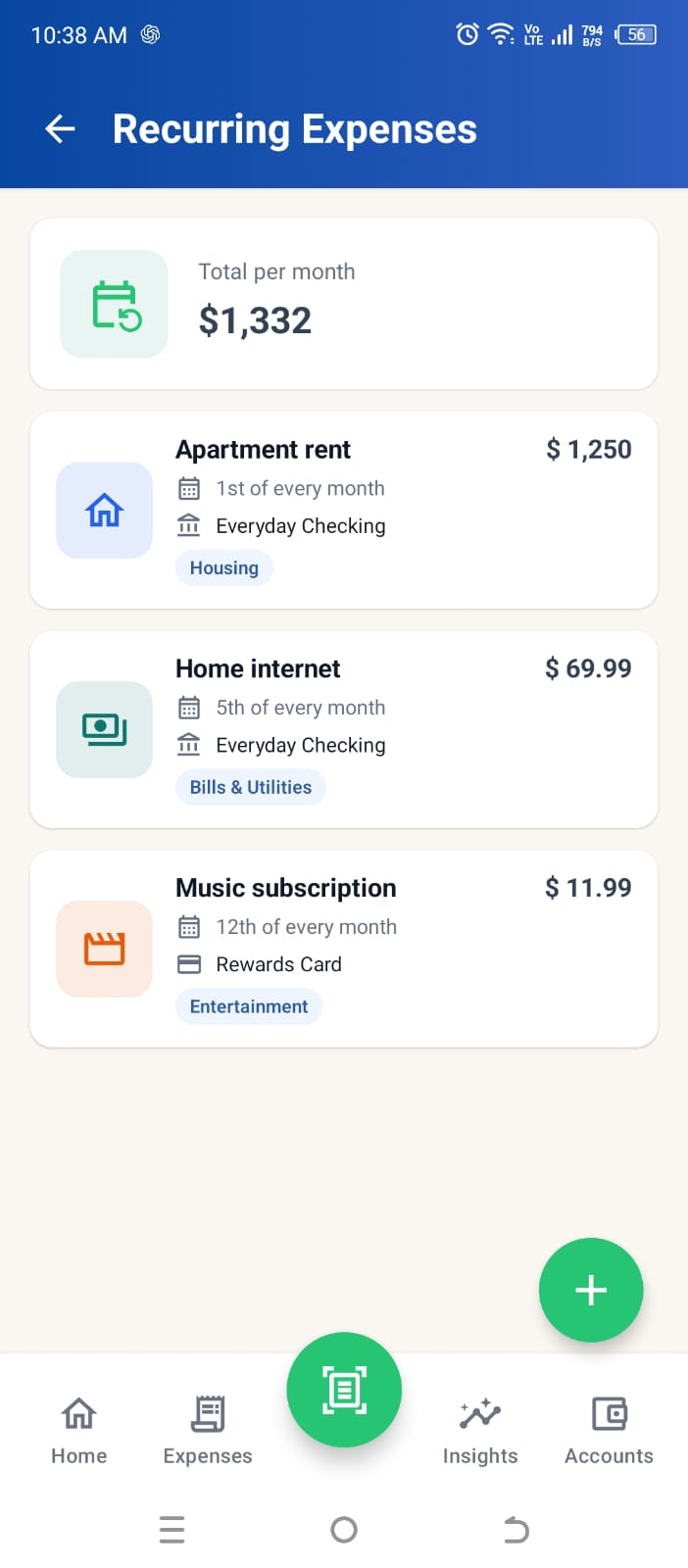
Screen shows sample data.
FAQ
Common questions
Is the AI bubble going to burst?
Nobody can say. Some economists and investors see bubble signs; others argue the spending is backed by real profits and fast-growing revenue. This article explains the debate, not a prediction.
How much is being spent on AI?
The largest US cloud companies planned more than $700 billion of spending for 2026, and JPMorgan estimates $5.5 trillion globally through 2030.
Is OpenAI profitable?
Not yet. Its own forecast, reported in September 2026, shows negative free cash flow of about $278 billion from 2026 to 2030.
Written with AI assistance by Higxel Editorial. Figures come from the sources listed; any example figures are labelled. This is general information, not financial or investment advice. Sources checked November 3, 2026. Some sources describe one country; local rules and costs differ.
Sources
Further reading
- Yahoo Finance: hyperscalers hit $700 billion in 2026 AI spending plans (May 2026)
- Fortune: JPMorgan on the $5.5 trillion AI capex boom (June 2026)
- The Star / Reuters: OpenAI forecasts cash burn near $280 billion by 2030 (September 2026)
- The Decoder: OpenAI Q1 2026 revenue and cash burn
- Sequoia Capital: AI's $600B Question (June 2024)
- Computing: MIT report on corporate generative AI pilots (2025)
- Fortune: Jason Furman on data centers and GDP growth (October 2025)
- Boston Globe: get ready to pay more for ChatGPT (April 2026)