Quick answer
The $20 plan is under pressure from both sides
AI companies spend far more running their services than they earn, and only a small share of users pay. To close that gap they have three levers: ads, higher prices, and less for free. OpenAI has already started the first, adding ads to its free and $8 Go plans in the US in 2026. Expect the cheapest plans to get more ads or fewer features, and keep an eye on what you pay each month.
Why your chats cost more than you pay
Every question you ask a chatbot runs on expensive chips in a data center that draws a lot of power. That is very different from streaming a film that was made once and copied millions of times. OpenAI's first quarter of 2026 shows the problem: about $5.7 billion of revenue and roughly $3.7 billion of cash burned, according to documents reported by The Information.
Meanwhile, analysts quoted by the Boston Globe estimate only about 5% of chatbot users pay. A marketing professor at Northeastern University, Koen Pauwels, told the paper the current pricing is "not a sustainable price" for these companies.
The price ladder is already here
The $20 plan feels like the standard, but it is already the middle of a much taller ladder. By mid-2026, every big AI company sold plans at $100 and $200 a month, mostly to heavy users and professionals.
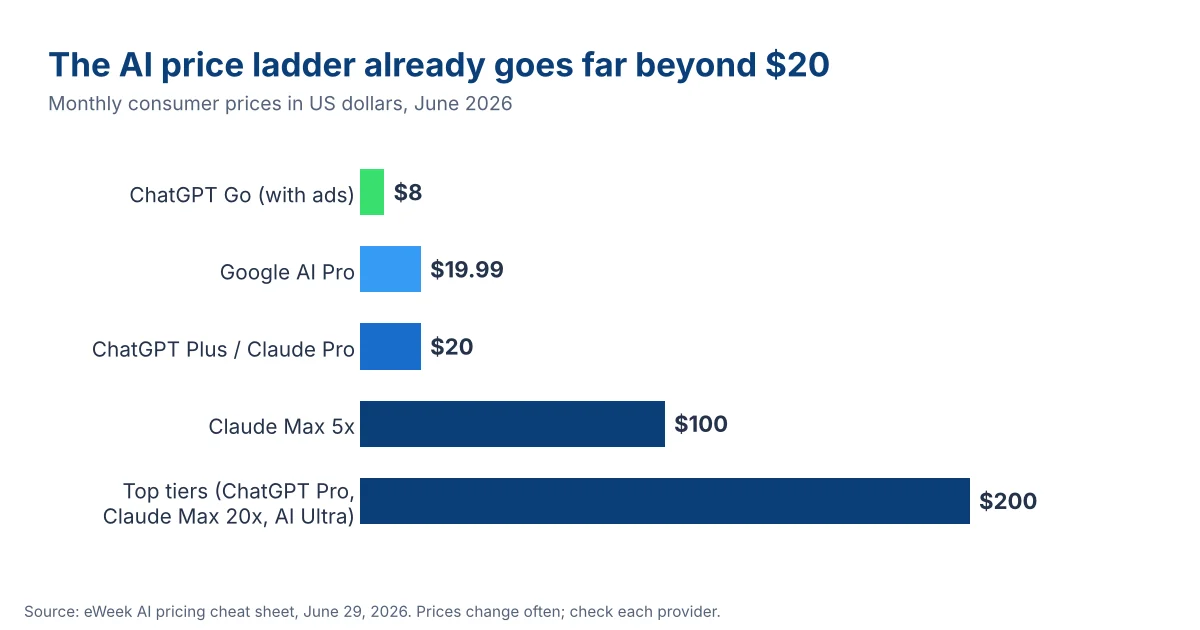
Usage limits do a lot of quiet work here. A cheaper plan does not need to get more expensive if it simply lets you do less before it asks you to upgrade.
Ads arrive first
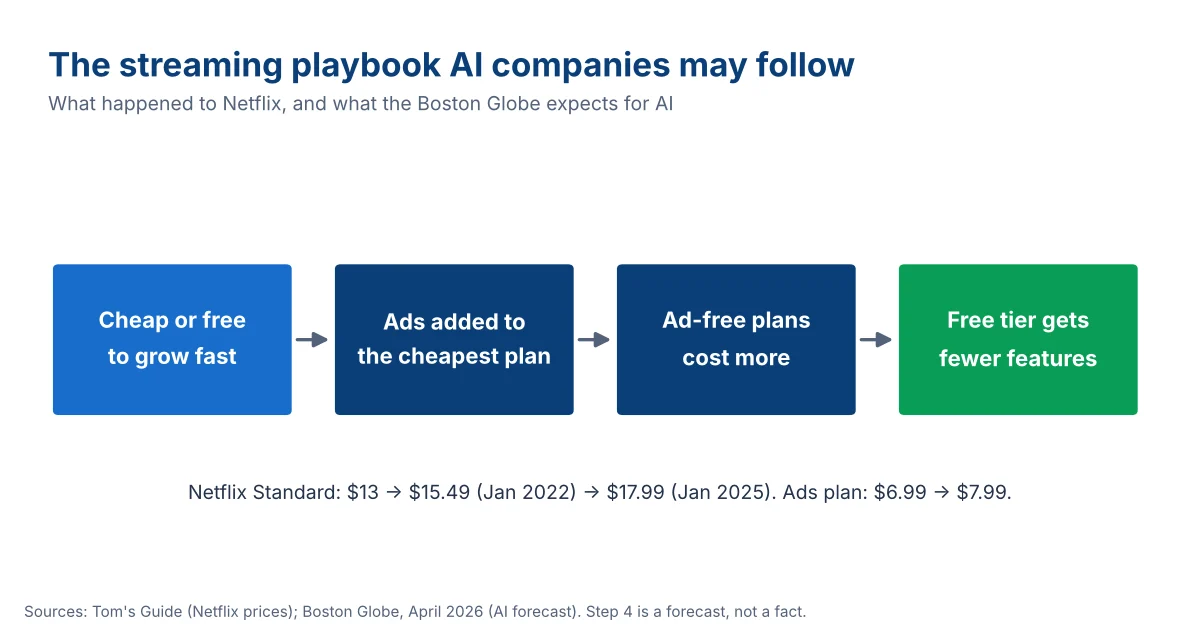
On January 16, 2026, OpenAI announced it would test ads for adult users of ChatGPT's free plan in the US, and on its new $8 Go plan. It said it would not share conversations with advertisers and would let users turn off ad personalization. Paid plans above Go stayed ad-free.
Anthropic, which makes Claude, has said it does not want advertising. The Boston Globe's technology columnist predicted it might change its mind if OpenAI's ad business succeeds. That is a forecast, not a fact, but it follows a familiar pattern.
How to keep AI subscriptions under control
- List every AI plan you pay for. Chatbots, image tools, writing assistants and "AI add-ons" inside other apps all count.
- Multiply by twelve. Two $20 plans are $480 a year. Seeing the yearly figure changes the decision.
- Check what you actually use. If one tool does most of your work, the second may be a habit, not a need.
- Watch renewal emails. Price changes are usually announced in an email you can easily miss.
- Try the cheaper tier for a month. Many people pay for limits they never reach.
- Add each AI plan as a recurring expense with its due day.
- Check the total in Insights to see what they cost each month.
- Change or remove a recurring expense when you cancel a plan.
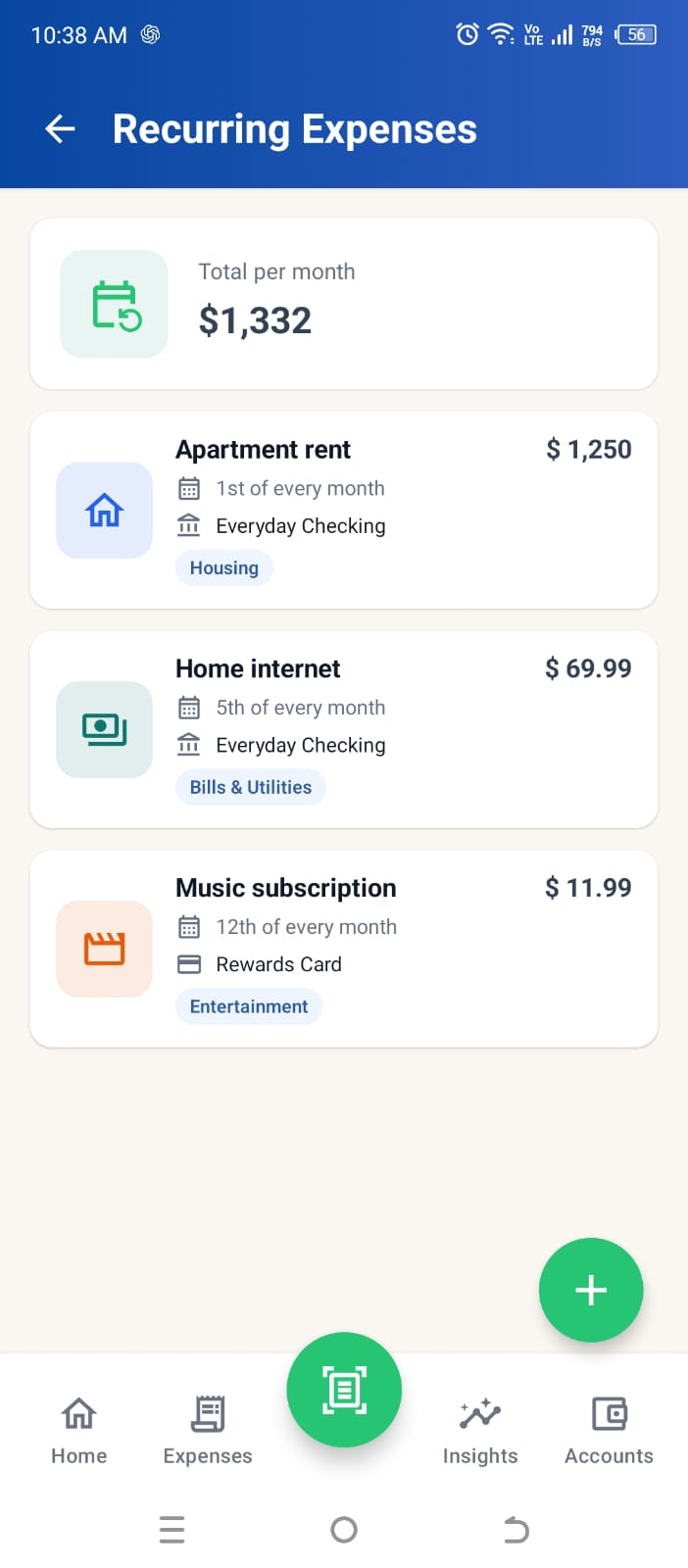
Screen shows sample data.
FAQ
Common questions
Is ChatGPT getting ads?
Yes, in the US. OpenAI began testing ads in early 2026 on the free plan and the $8 Go plan. Paid plans above Go were announced as ad-free.
Will ChatGPT Plus go up in price?
No price rise had been announced at the time of writing. Analysts expect pressure on prices because running AI is expensive and few users pay.
How much do AI subscriptions cost?
In mid-2026, most companies sold plans around $20 a month, cheaper plans from about $5 to $8, and heavy-use plans at $100 to $200 a month.
Written with AI assistance by Higxel Editorial. Figures come from the sources listed; any example figures are labelled. This is general information, not financial or investment advice. Sources checked November 3, 2026. Some sources describe one country; local rules and costs differ.
Sources