
Quick answer
Shareholders, lenders, taxpayers and some electricity customers
The AI build-out is paid for from four main places: the cash profits of big tech companies, a growing pile of debt (JPMorgan estimates $4.1 trillion by 2030), tax breaks offered by states to attract data centers, and in some regions higher electricity costs shared by all customers. Some deals also move money in a circle between chipmakers and their customers. Ordinary people are exposed through their savings, their taxes and their power bills.
Off the books: the Hyperion deal
Meta's Hyperion campus in Richland Parish, Louisiana, starts at about 2 gigawatts of computing, with plans to grow beyond 5. Instead of borrowing directly, Meta formed a joint venture: Blue Owl's funds own 80%, Meta owns 20%, and bond investors lent $27 billion against the project. Meta leases the buildings and has guaranteed some of their value for 16 years.
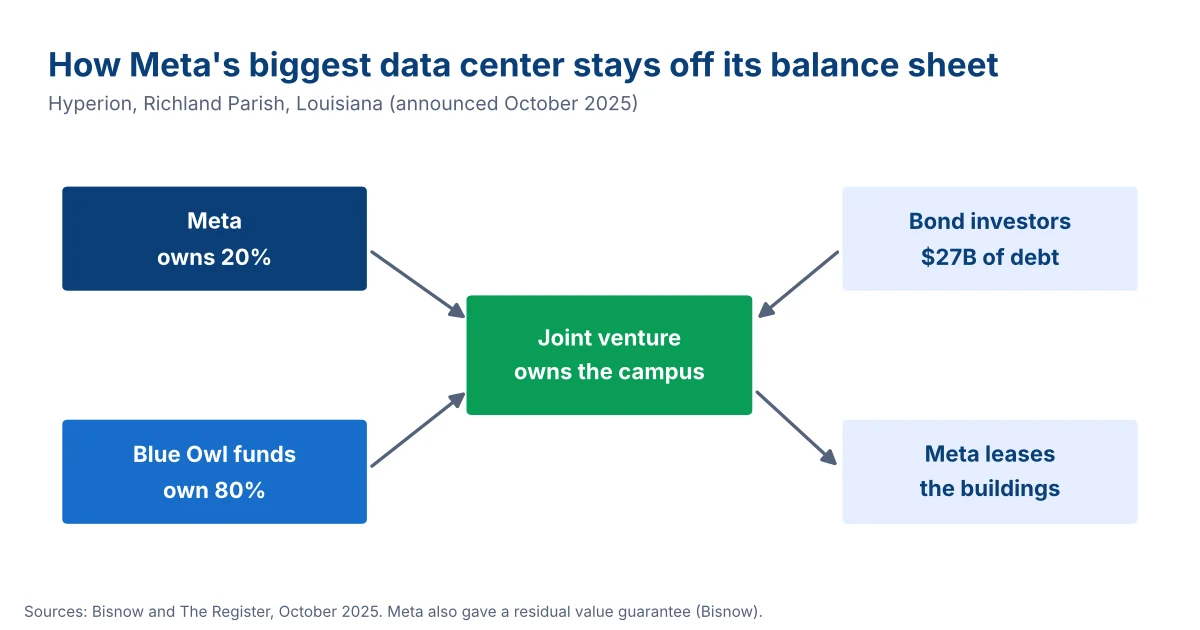
Meta says the structure keeps it flexible. Critics say it keeps big commitments away from the debt figures that credit-rating agencies and investors watch.
Money that travels in a circle
In September 2025, Nvidia announced it would invest up to $100 billion in OpenAI to help build data centers, which would be filled with Nvidia chips. One research firm estimated that every $10 billion Nvidia invested could come back as $35 billion of chip purchases or leases. Nvidia has also invested in cloud companies that buy its chips, and agreed to buy unused capacity from one of them.
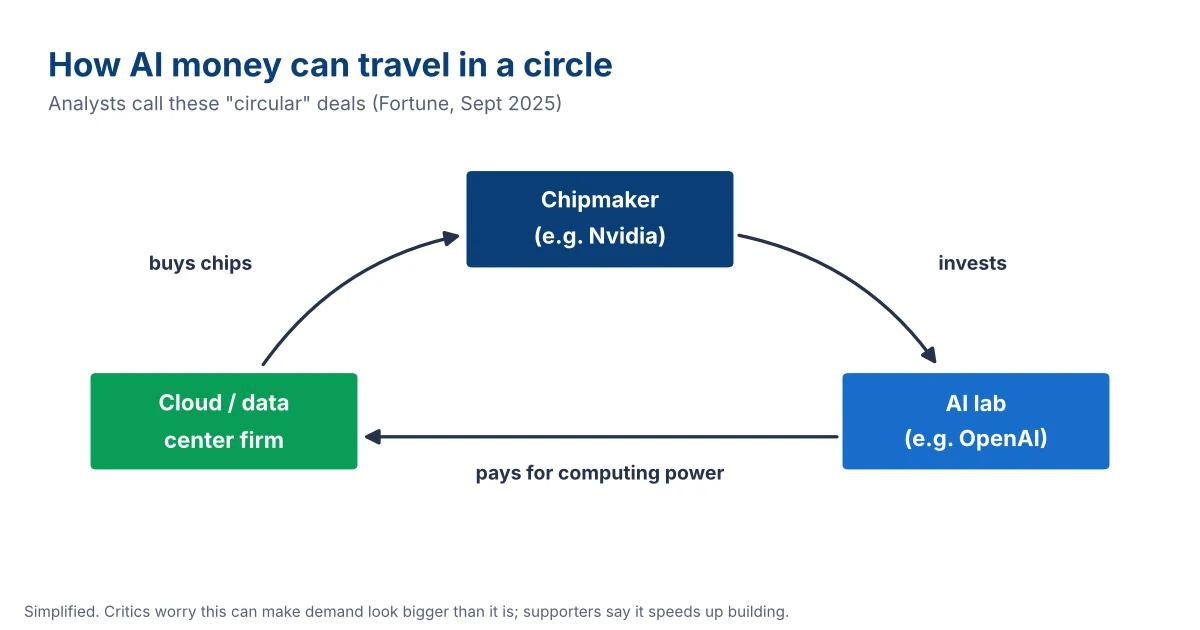
Supporters say this speeds up building and lets young AI companies borrow more cheaply. Critics worry it can make demand look stronger than it is. One analyst quoted by Fortune called it "bubble-like behavior."
A mountain of borrowing
JPMorgan expects about $4.1 trillion of debt to finance the AI build-out by 2030, often covering more than 85% of a project's cost. It expects US cloud giants alone to issue about $150 billion of high-grade bonds in 2026. Much of that debt ends up in pension funds, insurance companies and bond funds: in other words, in ordinary people's savings.
Tax breaks: the Virginia example
Northern Virginia hosts one of the world's biggest clusters of data centers, helped by a sales-tax exemption on their equipment. A state review found the exemption saved data centers about $928.6 million in taxes in 2023, and lawmakers in 2026 debated figures of around $1.9 billion a year. The same state review also found the exemption produced more jobs and income per dollar than most of Virginia's other incentives.
In 2026, Virginia kept the exemption, with conditions, through 2035, and added a tax on data-center electricity use of 1.1 cents per kilowatt-hour from July 2026, capped at $600 million a year. A further study is due by December 15, 2026.
Electricity customers
In regions with many data centers, part of the cost of new power capacity is shared by every customer. In the PJM grid in the eastern US, the market monitor estimated data-center demand added $9.3 billion to capacity costs for 2025–26. Our article on data centers and electricity bills explains how much of that reaches a household.
- Record utility bills as expenses to see if they creep up.
- Track subscriptions, including AI tools, as recurring expenses.
- Check Insights each month for anything that is quietly growing.
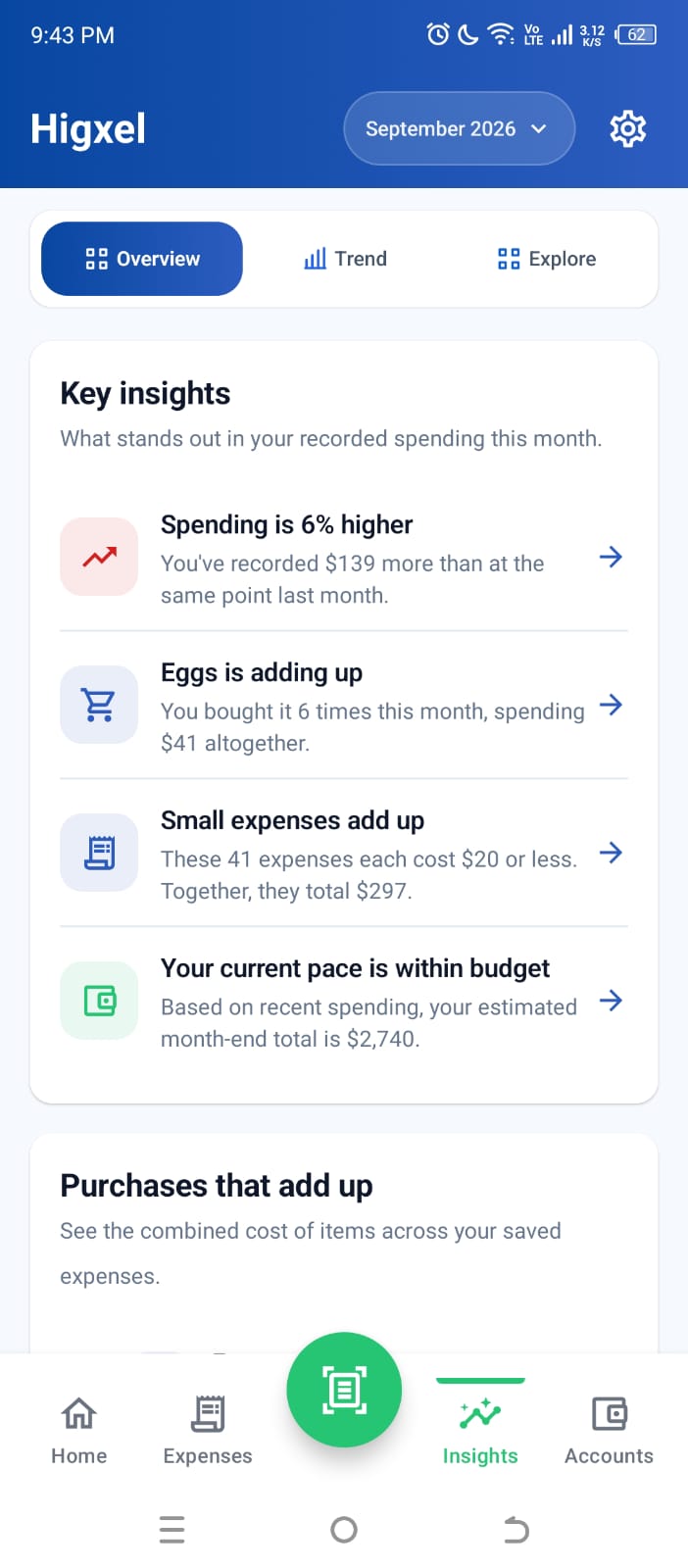
Screen shows sample data.
FAQ
Common questions
How is the AI boom being financed?
Through big tech profits, bonds and private credit, investments between AI companies and their suppliers, and state tax incentives. JPMorgan estimates $4.1 trillion of debt by 2030.
What is a circular AI deal?
A deal where a supplier, such as a chipmaker, invests in a customer that then spends the money on the supplier's products.
Do taxpayers pay for data centers?
Indirectly, in some places. Many states offer tax exemptions to attract data centers. Virginia's saved data centers about $928.6 million in 2023.
Written with AI assistance by Higxel Editorial. Figures come from the sources listed; any example figures are labelled. This is general information, not financial or investment advice. Sources checked November 3, 2026. Some sources describe one country; local rules and costs differ.
Sources
Further reading
- Bisnow: Meta pushes its largest data center project off its books (October 2025)
- The Register: Meta and Blue Owl Hyperion financing (October 2025)
- Fortune: Nvidia, OpenAI and circular financing (September 2025)
- Fortune: JPMorgan on AI capex and debt (June 2026)
- Holland & Knight: Virginia preserves data center tax incentive (August 2026)
- Cardinal News: state study on Virginia data center tax break (June 2026)
- PolitiFact: data centers and rising electricity costs (June 2026)